 The SZ had done the job it was meant to, but ultimately was quite hard to sell because of its extreme looks. A special racing class (the SZ Trophy) was introduced so the SZ (and RZ) could be used in competition on tracks all over Europe. Participants received a 25% discount on the not even exorbitant price of the cars in order to boost sales and to promote the series.

Regardless of the lacking commercial success of the SZ a new version appeared in 1992: the Roadster Zagato (RZ). Like the name indicates it was a convertible version of the SZ coupe. A year before Zagato had presented a SZ spider styling study, a remarkably elegant looking prototype SZ convertible with some curvy, almost feminine forms. But the actual RZ looked more like its SZ brother with angular shapes and the high waist line; more as if the SZ had been decapitated. However this car, unlike the SZ, was an original Zagato design.

A limited production of only 350 cars was announced, but the RZ proved to be even harder to sell than the SZ. Only 278 roadsters left the factory; 50 in 1992 and 228 in 1993. Like the SZ the RZ was sold and distributed outside Italy mostly by enthusiasts and specialists, and not by the official Alfa Romeo channels.

A remarkable feature in the interior are the "Kevlar" panels in the dashboard of the SZ, which give a racy light-weight impression. But it isn't really (expensive) carbon fibre material, only Fablon with a plastic coating. In the RZ these panels have been replaced by black coated aluminum panels.
The seats have no height adjustment and this means that taller people have reduced visibility in the RZ because of the low windscreen with the large top edge. The windscreen rim also acts as a roll-over bar in the RZ, hence its size.

Underneath the body not much was changed. Like the SZ the new RZ featured the 3.0 litre V6 with 210 hp and 245 Nm. A nice aspect of this engine is the even availability of torque: between 2500 and 6000 rpm there's always at least 230 Nm available. This makes the SZ and RZ flexible cars to drive, equally competent at touring as at performance driving. A downside to the RZ is its weight: 1380 kg, an increase by 120 kg causing it to be less nimble than the SZ. Maximum speed of the RZ is 230 kph and the car is capable of a 0-100 kph acceleration in 7.5 seconds.

The body of the RZ shows some revisions from that of the SZ. Most notably of course the (unlined) fold away top which disappears in a space behind the seats, under a lid with two typical Zagato bulges. Other changes include different side windows to fit the top, a new engine cover, now without the ribbed segment in the middle part in front of the windscreen, more concealed window wipers, a higher front spoiler to offer more ground clearance, revised side-skirts and a darker rear light strip.

Less noticeable but also a remarkable difference from the SZ is the utilization of thinner plastic panels in order to reduce weight. In all, creating the RZ required more than 500 new parts and all moulds for the plastic components had to be renewed. Quite expensive for such a limited production run.
With the top down the roadster looks less harmonious than the coupe, it gives an impression of a chunky wedge. It takes a lot of getting used to, but on the other hand it conveys a butch brutality, like a pumped up body-builder. The RZ is definitely a car for those who like to be noticed as non-conformists.

A typical Alfa Romeo characteristic can be found in the drive train of the SZ and RZ: the transaxle transmission construction. This means that the gearbox isn't directly attached to the engine, but to the rear axle, combined with the (limited slip) differential. The construction offers a better weight distribution with enhanced road holding as a result, but always had the downside of an indirect, uncomfortable gear change.
 The Alfa Romeo
 The Alfa Romeo
 The Alfa Romeo
 Alfa Romeo Scighera
 Alfa Romeo Scighera
 Alfa Romeo Scighera

 The Alfa Romeo Brera is a sports car produced by the Italian automaker Alfa Romeo since 2005. The Spider roadster has been produced since 2006. Both cars are manufactured by Pininfarina.


 In Spring 2008 the Brera 'S' Special Edition was announced. This Alfa Romeo-approved British-only limited-run version was developed by British engineering specialists Prodrive and was intended to address criticism regarding the handling of the standard car. The suspension and chassis settings of the 'S' have been amended from the standard car, altering the handling characteristics. Alfa Romeo and Prodrive had previously collaborated in Motorsport, campaigning an Alfa Romeo 155 in the BTCC during 1994 and 1995.

 The New Spider version (Type 939) was introduced at the 2006 Geneva Motor Show, where it also received "Cabrio of the Year" award. Spider is based on the Brera coupe but is a pure 2-seater convertible.


 The Alfa Romeo MiTo (known internally as the type 955) is a three door sporty supermini officially introduced on 19 June 2008 in Castello Sforzesco in Milan and the international introduction was at British Motor Show in 2008. The car was available in all Alfa's major markets in stages from July. The three-door hatchback is front-wheel drive and will be sold to compete with the MINI and the upcoming Audi A1. Designed by Centro Stile Alfa Romeo, the design is believed to be inspired by the 8C Competizione.


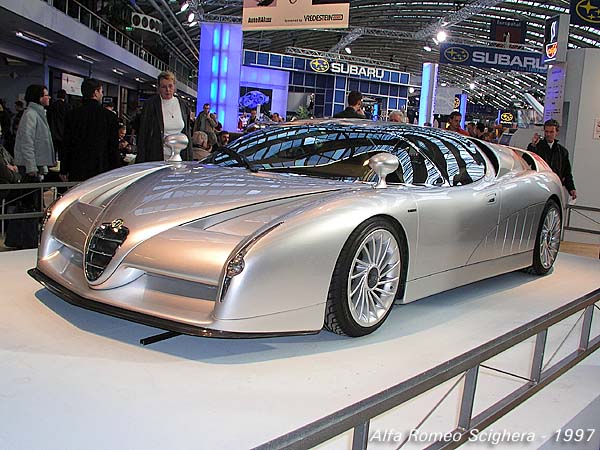
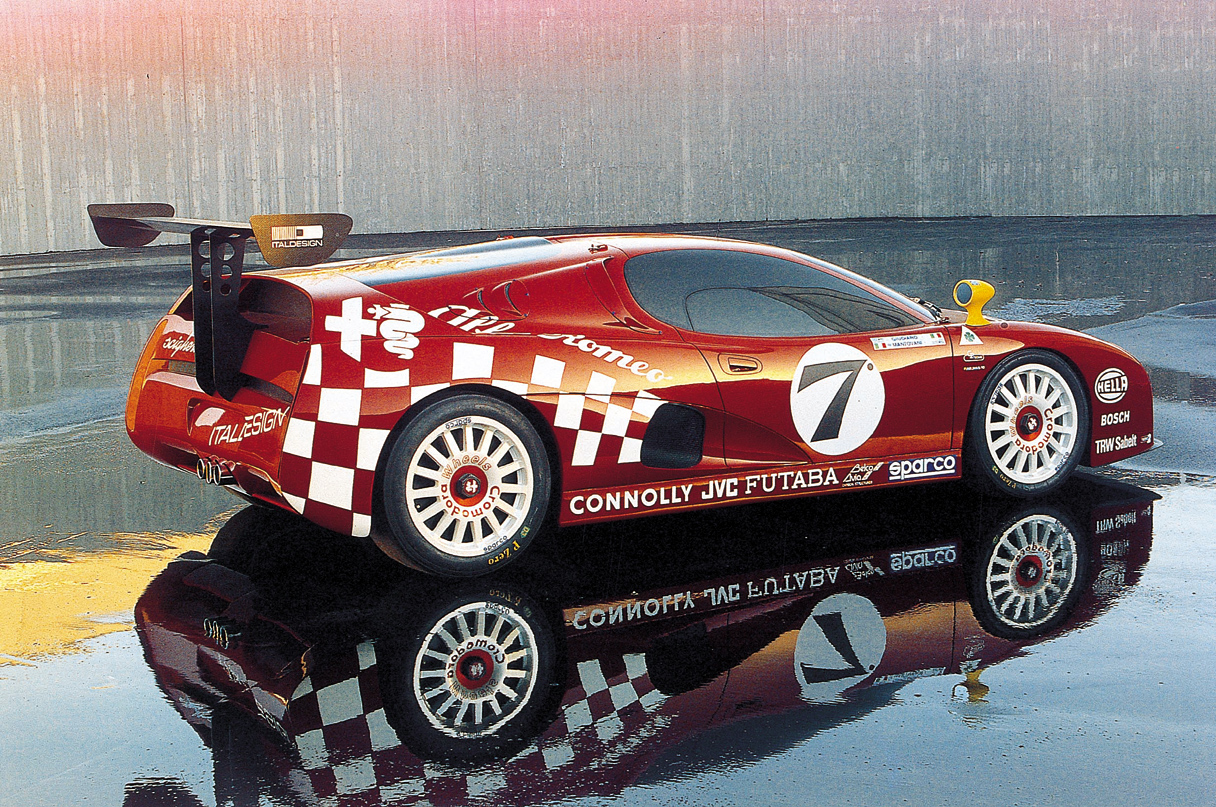
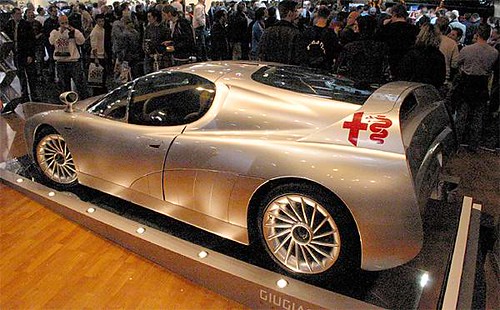
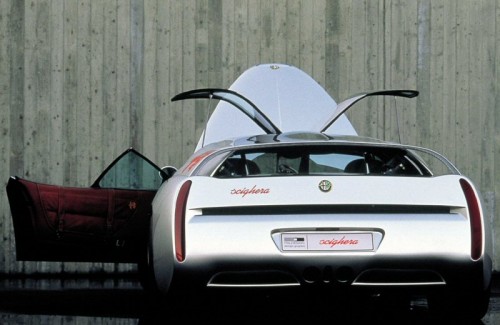
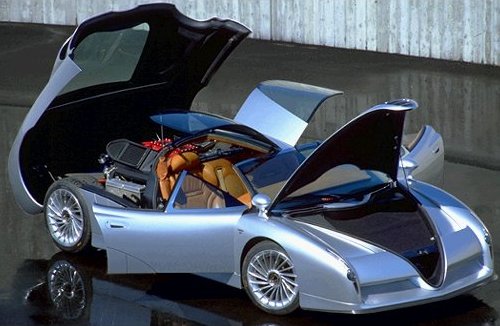
 The Alfa Romeo Scighera was one of the oldest show cars present this year. But this design by Fabrizio Giugiaro, son of the well-known designer and founder of the ItalDesign studio Giorgetto Giugiaro, looks timeless. It's a mid-engined super sports car aimed to connect Alfa's modern technology to their famous racing past. At the time of its introduction at the Geneva Auto Show in 1997 the board of the Fiat Group, of which Alfa Romeo is a part, weren't impressed by it and more or less neglected the car., but in the way time works this was all to change, as you'll see further on.
 The Scighera is not just some show car, it's actually fully registered for road use. Even a limited scale production was considered for some time by ItalDesign. It's powered by Alfa's 3-litre V6 from the 164 sedan model, which is boosted to produce some 400 hp by a twin-turbo system. To get this amount of power on the road it features the four wheel drive technology from the Lancia Delta Integrale (which was also offered on the Alfa 155) and a 6-speed sequential transmission. At a vehicle weight of 1200 kg it must be a bomb to drive.
 The Brera is a more recent attempt by ItalDesign at designing an Alfa Romeo sports car, and it looks to be a more viable one too. It was first shown at the 2002 Geneva Auto Show and remarkably its characteristics are not that much different from the Scighera, they're only more realistic in execution. The Brera is also constructed from lightweight materials, with a body made entirely from carbon fiber, and features 400 hp with all-wheel drive and sequential transmission as well. Only in this case a 4.2-litre V8 of Maserati origin, placed in front of the passengers compartment, is used to obtain a 402 hp power output.
 This time the design is credited to Giugiaro senior and the exterior is not so much timeless as it is modern contemporary. It has the "blob" like appearance as shown by a number of concepts by other manufacturers/designers, apparently the current fashion for 2+2 GT cars. But its razor sharp front-end design, the creases on the sides and the pointy rear makes this design stand out in a positive manner. The long, aggressive nose makes no secret of the road-devouring potential of this car, and its width (1.9 m) combined with its low height (1.3 m) makes it seem to have a rock-solid road holding.