Saturday, May 29, 2010

Mercedes-Benz CLK GTR LM Road Car

Mercedes-Benz CLK GTR LM

The Mercedes-Benz CLK GTR was intended to enter in the 1997 FIA GT Championship sportscar racing world championship series, known as BPR Global GT Series up to 1996. To be allowed to do so, 25 cars had to be built for the GT1 class. Porsche 911 GT1, McLaren F1, Ferrari F40 and others were already competing there, Nissan R390 GT1 and Toyota GT-One joined in later, at the 1998 24 Hours of Le Mans.

After the CLK GTR won all World Championships titles it competed for in 1997 and 1998, the GT1 class was cancelled as no competitor showed up for 1999. In that year, the required road cars were finally delivered.

Mercedes-Benz CLK GTR LM

Mercedes-Benz CLK GTR Roadster - Click above for a high-res image gallery

Supercars like the SLS AMG and SL65 AMG Black Series might be the flagships for the current Mercedes-Benz lineup, but back in the late 1990s it was all about the CLK GTR -- an all-out race car slightly disguised as a road car. The street version you see here was built to homologate the race car that competed in the FIA's GT1 class in 1997 and 1998 (wining the championship in 1997). Each came with a 6.9-liter V12 putting out 612 horsepower as well as features found on modern supercars like a sequential six-speed transmission with paddle shifters and carbon fiber brakes. Just 25 examples were built including five roadsters, making the CLK GTR one of the most exclusive supercars ever built.

It's for this reason that the auction of two CLK GTR road cars immediately caught our attention. Both will be offered at RM Auction's Automobiles of London sale on October 28. One coupe and one roadster will go across the block, each completely brand new and unregistered with delivery miles only. Interestingly, both cars are right hand drive, custom built for the original owner. RM lists the estimated price for each CLK GTR at around 1/3 the original cost to build the cars, meaning some lucky collector might take home a supercar for a bargain. Follow the jump for more details about both cars, or check out the stunning high-resolution gallery below.

Thursday, May 27, 2010

Ferrari 512s Pictures and Images

Ferrari 512S
Ferrari 512 S was the designation of 25 five litre sports cars built until January 1970, related to the Ferrari P sports prototypes. The V12-powered cars were entered in the 1970 World Sportscar Championship season by the factory (Scuderia Ferrari, SEFAC) and private teams. Later that year, modified versions resembling the main competitor Porsche 917 were called Ferrari 512 M (for modificata). In the 1971 World Sportscar Championship season, the factory focused on the new Ferrari 312PB and abandoned the 512 which was only entered by privateers. From 1972 onwards, the 512 (as the 917) was withdrawn from the world championship following a change in the regulations, and some 512 in private hands were entered in CanAm and Interserie races.

History

Until 1967, Ferrari raced four litre prototypes (see Ferrari P), but due to high speeds achieved in Le Mans also by the seven litre V8 Ford GT40, the rules were changed for 1968 limiting Group 6 Prototypes to a maximum engine capacity of 3.0 litres, as in Formula 1. Despite having a suitable engine, Ferrari sat out the 1968 season, to return in 1969 with the Ferrari 312P. In that year, Porsche had taken full advantage of a loop hole with the Porsche 917, making the risky investment of building 25 examples of a 5.0 L car to allow homologation into the FIA's Group 5 Sports Car category. Selling a part of his business to Fiat, Enzo Ferrari raised the funds to match that risky investment. Surplus cars were intended to be sold to racing customers, which means that several dozen high powered sports cars were available, and with each requiring two drivers in an endurance race, there was a shortage of experienced pilots.

The motor of the 512S was a total new 60° V12 with 560 PS (412 kW) output. Compared to Porsche's air-cooled flat-12, it needed a maze of cooling pipes and a heavy radiator. Since the chassis was of sturded steel, reinforced with aluminium sheet, weight was 100 kg more than that of the alloy-framed 917. Notwithstanding the weight difference and higher center of gravity, the Ferrari 512S and Porsche 917 were theoretically fairly even matched.


Ferrari 512S
Ferrari 512S
Ferrari 512S

1970 Ferrari 512S

Sold for: $3,564,000
By: RM Auctions
When: May 20, 2007
Where: Maranello, Italy

This Ferrari race car is one of only four like it, according to RM Auctions. The car has an extensive racing history, including races at Le Mans and the 24 Hours of Daytona. Sports Car Market said the car was "cosmetically disappointing close-up," but its racing history justified the price. "Well bought, as it'll cost even more next time,"

Photos from the Ferrari Festival at Mt-Tremblant, Quebec 2008

300S 3072
Maserati 300S s/n 3072

200 SI 2401
Maserati 200 SI s/n 2401

8C 35 (Giddings)
Peter Giddings' Alfa 8C 35, s/n 50008


GTO (Jon Shirley)
Ferrari 250 GTO s/n 3729

512S 1046
Ferrari 512S s/n 1004

Venturi 300 Atlantique Images

300 Atlantique
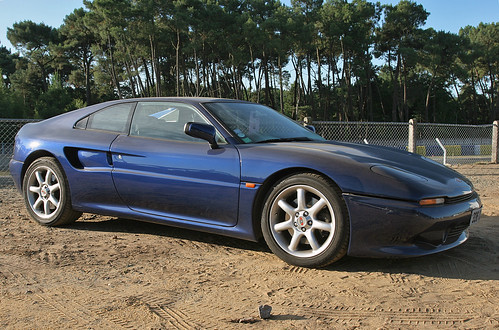
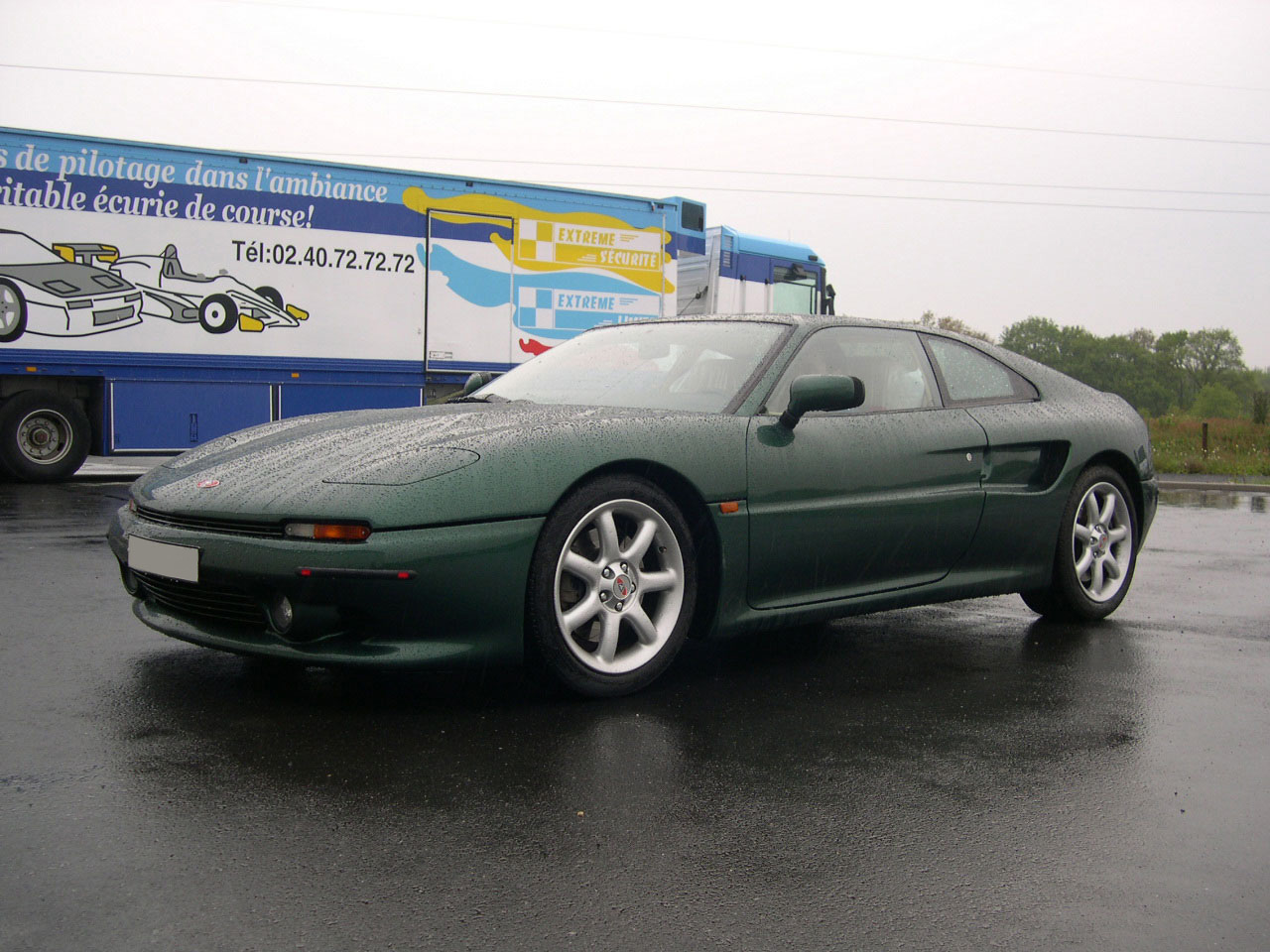
The Venturi Atlantique was a mid-engined, fiberglass-bodied French sports car produced by Venturi Automobiles from 1991 to 2000.

Atlantique 300

Scotsman Hubert O'Neill purchased Venturi in 1994 and conceived of the Venturi 400GT as well as a revised Atlantique. After a rushed design time of six months, the new Atlantique 300 was unveiled at the Paris Motor Show. Its new 3.0 24V V6 engine was lifted from other Peugeot/Citroën models and was good for 210 hp (157 kW; 213 PS) in naturally-aspirated form or 281 hp (210 kW; 285 PS) with a turbocharger.

Venturi again went into receivership in 1996, and was bought by Thai firm Nakarin Benz, under whom the company focused its concentration upon road cars. The biturbo version Atlantique 300 was released in 1998 and brought the power up to 310 hp (231 kW; 314 PS). With a top speed of 171 miles per hour (275 km/h) and a 0-60 miles per hour (97 km/h) time of 4.9 seconds, this addition made the Atlantique a serious performance competitor to the Lotus Esprit V8.


300 Atlantique
Venturi 300
Venturi Atlantique
Venturi Atlantique 300
Manufacturer Venturi Automobiles
Production 1991-2000
Assembly Couëron, Pays de la Loire, France
Body style(s) 2-door coupe
Layout mid-engine, rear-wheel drive
Engine(s) 2.8L V6 turbo 3.0L V6 N/A, turbo or biturbo
Transmission(s) 5-speed manual transmission
Designer Claude Poiraud, Gérard Godfroy

Venturi 300
Venturi 300
Venturi Atlantique
Venturi Atlantique

Monday, May 24, 2010

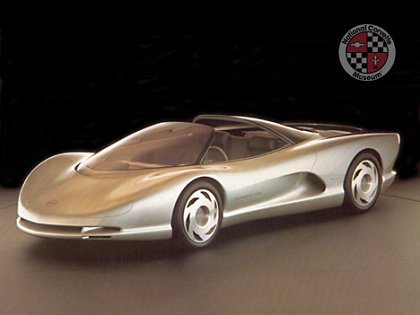
Chevrolet Aerovette

Chevrolet Aerovette


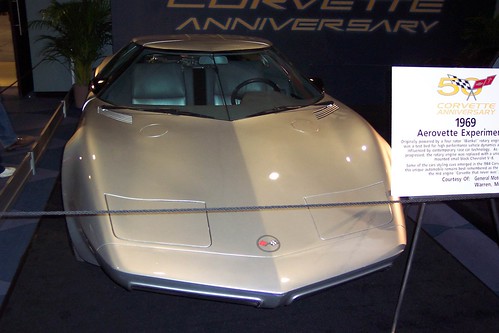
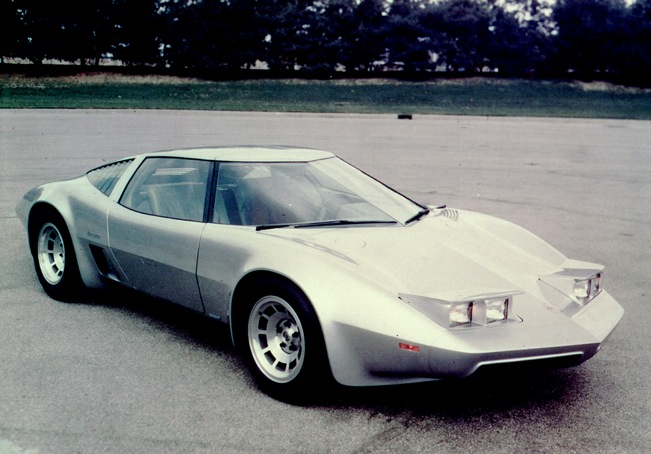
The Chevrolet Aerovette is a concept car created by the Chevrolet division of General Motors, beginning life as Experimental Project 882 (XP-882). It has a mid-engine configuration using a transverse mounting of its V-8 engine. Zora Arkus- Duntov's engineers originally built two XP-882s during 1969, but John DeLorean, Chevrolet's general manager, canceled the program because it was impractical and costly. But when Ford announced plans to sell the DeTomaso Pantera through Lincoln-Mercury dealers, DeLorean ordered one XP-882 cleaned up for display at the 1970 New York Auto Show.

In 1972, DeLorean authorized further work on the XP-882 chassis and gave it a new project code, XP-895. A near-identical body in aluminum alloy that resembled the XP-895 was constructed, and became the "Reynolds Aluminum Car." Two of the Chevrolet Vega 2-rotor engines were joined together as a 4-rotor, 420 horsepower (310 kW) engine, which was used to power XP-895. The XP-895 was first shown in late 1973. Another Corvette concept, XP-897GT, also appeared in 1973, which used a 2-rotor engine. However, with the energy crisis of the time, GM scrapped its rotary development work and all plans for a Wankel-powered car. The XP-897GT 2-rotor Concept was sold to Tom Falconer and fitted with a Mazda 13B rotary engine in 1997.

Chevrolet Aerovette Concept
1977 Aero-Vette.jpg 1977 Chevrolet Aerovette Concept
Manufacturer Chevrolet Motor Division
Parent company General Motors Corporation
Class Sports car
Body style(s) 2-door convertible
Designer Chevrolet Design Staff

Chevrolet Aerovette
Chevrolet Aerovette
Chevrolet Aerovette
Chevrolet Aerovette

Chevrolet Corvette Cars Photos

2007 Chevrolet Corvette
The Chevrolet Corvette is a two-seater sports car by the Chevrolet division of General Motors. The first model was designed by Harley Earl and introduced in 1953. Myron Scott is credited for naming the car after the corvette, a small, maneuverable warship.[1] It has been produced in six generations in coupe, convertible, t-top coupe, and targa coupe body styles. Originally built in Flint, Michigan and St. Louis, Missouri, it is currently built at a GM assembly plant in Bowling Green, Kentucky. The National Corvette Museum, also located in Bowling Green, documents the car's worldwide history and hosts an annual National Corvette Homecoming. In 2003, the Corvette became the first and only American sports car to celebrate its 50th anniversary.[2] The Chevrolet Corvette is often marketed as, and quoted as being "America's Sports Car".
2008 Chevrolet Corvette
Chevrolet Corvette
2008 Chevrolet Corvette
1986 Chevrolet Corvette
Chevrolet Corvette

Sunday, May 23, 2010

Ferrari Modulo Cars Pictures

Ferrari Modulo

The Ferrari 512 S Modulo is a concept car designed by coach maker Pininfarina, unveiled at the 1970 Geneva Motor Show.

By January 1970, Ferrari had built a series of twenty-five Ferrari 512 S racing cars for homologation purposes, just like Porsche had done in 1969 with the Porsche 917. This meant that dozens of high powered mid-engined race cars were available. Ferrari could not race or sell all of the manufactured cars, and gave chassis number 1046 (that means the 23rd) to Pininfarina.

The Modulo was the last in a series of studies. The concept car has an extremely low body with a Canopy-style roof that slides forward to permit entry to the cabin. All four wheels are partly covered. Another special feature of the design consists of twenty-four holes in the engine cover that reveal the Ferrari V12 engine.

Ferrari 512 S Modulo
Ferrari Modulo
Manufacturer Ferrari
Parent company Fiat Group
Production 1970
1 unit
Predecessor N/A
Successor N/A
Class Concept car
Body style(s) semi-monocoque
Layout RMR layout
Engine(s) 5.0 L V12
Transmission(s) 5-speed manual
Wheelbase 2405 mm (94.7 in)
Length 4480 mm (176.4 in)
Width 2040 mm (80.3 in)
Height 935 mm (36.8 in)
Curb weight 900 kg (1984 lb)
Related Ferrari 512 S
New Render for Ferrari Modulo
Ferrari Modulo
Ferrari Modulo
Ferrari Modulo
Ferrari Modulo
Ferrari Modulo